Searches products, guides and pages — e.g. “Monstera”, “grave care” or “delivery”.
Cut Flowers > Tulips
Yellow Tulips (Tulipa × gesneriana) – Cut Bouquet
Gelbe Tulpen (Tulipa × gesneriana) bringen mit ihren geschlossenen bis leicht geöffneten Blüten frische Frühlingsfarbe in die Vase. Der gebundene Schnittstrauß zeigt kräftige grüne Blätter und eignet sich für helle, eher kühle Innenräume.
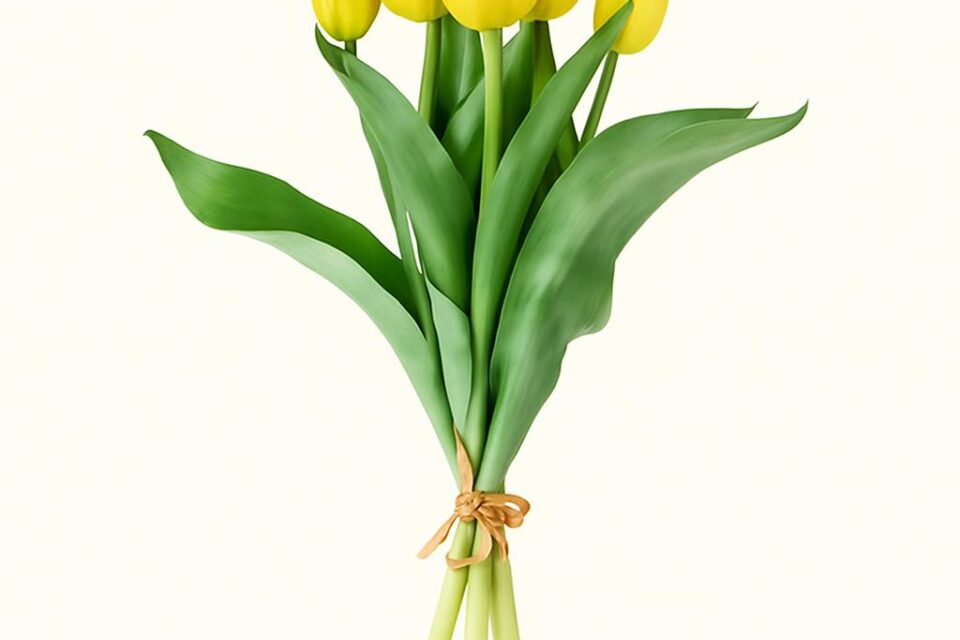
Yellow tulips (Tulipa × gesneriana) bring a clean, seasonal splash of colour to an indoor display. The pictured bouquet contains several cut tulips with upright green stems, broad lance-shaped leaves and yellow, cup-shaped flowers.
Tulips continue to grow in the vase and naturally bend towards the light. A bright, cool position away from direct midday sun helps the flowers last longer. Before arranging them, recut the stem ends straight with a clean, sharp knife and use only a shallow level of cold water.
Check the water daily, replace it regularly and remove any leaves below the waterline. Keep the bouquet away from radiators, draughts and ripening fruit, as warmth and ethylene may speed up flower ageing. The precise cultivar cannot be identified reliably from yellow flower colour alone.
Polisi plant knowledge
Care guide
The essentials first, followed by clear, practical details for every care topic.
Botanical nameTulipa × gesneriana, eine Gartentulpen-Hybride aus der Familie der Liliengewächse (Liliaceae); die Sorte ist visuell nicht bestimmbar.
01
Watering
Fill a clean vase with approximately 500–1000 ml of fresh, cold water, leaving the lower 5–8 cm of the stems submerged. Check the level visually every day throughout the year, top up as required and replace all the water at least every 1–2 days. Avoid submerged leaves and stale standing water; bulbs grown in soil must never remain waterlogged.
02
Light
Place in bright to partly shaded light, away from direct midday sun. Cut tulips last longer in diffused light and naturally curve towards the light source.
03
Best location
Choose a bright, cool indoor position for the vase. Keep it away from radiators, strong draughts and ripening fruit, and place it securely beyond the reach of children and pets.
04
Temperature
A temperature of around 10–18°C suits cut tulips, and cooler nights may extend their vase life. Temperatures above 20°C generally cause the flowers to open and fade more quickly.
Foundation
Soil & nutrition
Humidity
Normal indoor humidity of roughly 40–60% is suitable. Do not mist the flowers, as moisture remaining on the petals can encourage spotting and decay.
Soil
The cut bouquet does not require soil. When grown in the garden, tulips need loose, humus-rich to sandy loam that drains very freely and has a neutral to slightly alkaline pH; improve heavy soil with grit or coarse sand.
Nutrient needs
Cut-flower food mainly provides sugar, acidity regulators and hygiene-supporting ingredients for the vase water. Garden-grown tulips have moderate nutrient needs; balanced feeding with sufficient potassium supports firm stems and bulb reserves, while excess nitrogen encourages soft growth.
Fertilising
Add cut-flower food at the manufacturer’s stated rate whenever the vase water is replaced; never make the solution stronger. For garden cultivation, apply a potassium-rich bulb fertiliser at the labelled rate from early spring until flowering ends, then stop once the foliage dies back.
Planting
For vase use, recut 1–2 cm from the stem ends with a clean tool, remove the lower leaves and place the stems immediately into a clean vase. For garden cultivation, plant bulbs in autumn about 10–15 cm deep with the pointed end upwards, or at approximately two to three times the bulb’s height.
Plant spacing
For garden planting, allow approximately 8–12 cm between bulbs. Arrange cut stems loosely in the vase so air can circulate and the leaves are not kept tightly compressed.
Through the year
Flowering & seasonal care
Flowering period
The natural flowering season is mainly from March to May, depending on the tulip group and weather. As a cut flower, the yellow cup-shaped bloom opens more quickly in warmth and may partly close again under cooler, darker conditions.
Pruning
When changing the vase water, trim a few millimetres to 1 cm from the stem ends with a clean tool and remove faded flowers or damaged leaves. On garden plants, remove only the spent bloom and allow the foliage to turn fully yellow before cutting it back.
Repotting
Repotting is not relevant to the cut bouquet. Move container-grown bulbs only after their foliage has died back and when the compost is compacted or the bulbs are overcrowded; use fresh, free-draining compost and a container with drainage holes.
Overwintering
Keep the cut bouquet cool but frost-free. For garden cultivation, plant bulbs in autumn and overwinter them outdoors; protect containers from freezing solid and prolonged winter wet by using a sheltered position and insulating wrap.
Hardiness
Garden tulips in free-draining soil are generally winter hardy in Austria to approximately −20°C, although actual tolerance depends on the cultivar, soil moisture and site. Cut stems are not frost hardy and must not be allowed to freeze.
Plant profile
Growth & origin
Life cycle
Botanically, this is a perennial bulb with spring growth and flowering followed by summer dormancy. As a cut flower, it is a seasonal product with a limited vase life.
Mature size
Garden tulips commonly reach about 30–60 cm in height, depending on their group. The exact length of the pictured stems cannot be measured without a scale; tulip stems may continue to extend by several centimetres in the vase.
Pot / sale size
The pictured cut bouquet is not intended for a pot. For container cultivation, pots at least 20 cm in diameter and 20 cm deep, with several drainage holes, are expressly recommended; plant several bulbs with suitable spacing according to the container’s size.
Origin
Garden tulips are hybrids developed through long-term breeding from tulip lineages centred in Western and Central Asia. The exact parentage and production location of the pictured bouquet cannot be established from the photograph.
Propagation
The cut bouquet cannot be propagated. Garden tulips are multiplied using offset bulbs; seed propagation is possible, but hybrid seedlings do not remain true to type and require several years to flower.
Good to know
Healthy & safe
Safety and toxicity
All parts are considered harmful if eaten, especially the bulbs. Ingestion may cause gastrointestinal upset, and the sap may irritate sensitive skin. Do not consume, keep away from children and pets, and seek medical or veterinary advice if symptoms occur.
Common problems
Common vase issues include bending or rapidly lengthening stems, fast opening in warm rooms, cloudy water and decay caused by submerged leaves. A clean vase, cool position, shallow fresh water and regular water changes help; garden-grown tulips may also be affected by bulb rot, grey mould, aphids and slugs.
Note: Location, season, pot size and weather can change the plant’s actual care needs.