Searches products, guides and pages — e.g. “Monstera”, “grave care” or “delivery”.
Biennial bedding and container plants
Wood forget-me-not – Myosotis sylvatica
Das Wald-Vergissmeinnicht (Myosotis sylvatica) bildet im Frühling lockere Büschel aus kleinen, himmelblauen Blüten mit hellem Auge. Es eignet sich für halbschattige Beete, Gehölzränder und ausreichend große Pflanzgefäße mit gleichmäßig feuchter Erde.
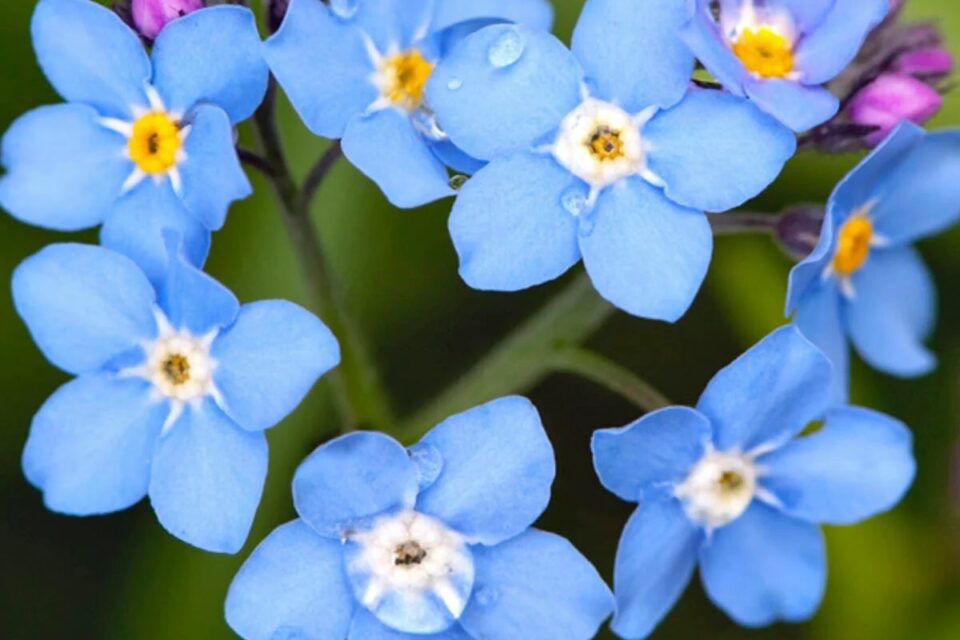
Wood forget-me-not (Myosotis sylvatica) carries numerous five-petalled blue flowers from April to June. Its buds are often pink at first, opening into flat blooms with white to yellow centres.
Its compact to loosely upright habit works well along woodland edges, in naturalistic spring borders and in outdoor containers. A bright, partly shaded position with humus-rich, free-draining soil that stays evenly moist supports a longer flowering period. It can also grow in sun if the soil is not allowed to dry out.
Myosotis sylvatica is generally biennial or a short-lived perennial and often maintains itself by self-seeding in a suitable position. Remove fading flower stems before the seeds mature if spreading is not wanted. The visible flowers do not provide enough evidence for a named cultivar, so the plant is offered at species level.
Polisi plant knowledge
Care guide
The essentials first, followed by clear, practical details for every care topic.
Botanical nameMyosotis sylvatica
01
Watering
For a 10–12 cm pot, apply approximately 150–250 ml as needed, watering thoroughly enough to moisten the entire root ball and allowing all excess to drain. In a border, provide about 5–10 l/m² during dry weather. From March to June, check once to three times a week and daily in hot conditions; water when the top 1–2 cm of soil feels slightly dry. Check pots every 7–14 days in autumn and winter, watering only when the root ball is beginning to dry. Never leave the plant standing in water or in persistently waterlogged soil.
02
Light
Bright partial shade is ideal. Morning or evening sun is suitable; full sun is only recommended in a cool position where the soil remains reliably moist. Deep shade reduces flowering and encourages weaker growth.
03
Best location
Suitable for partly shaded spring borders, woodland edges, naturalistic planting, window boxes and outdoor pots. Choose an airy position sheltered from intense midday sun to reduce drought stress and fungal disease.
04
Temperature
Temperatures of about 8–18°C are favourable during active growth and flowering. Established plants tolerate frost, but newly purchased, forced plants should be protected from severe late frosts and gradually acclimatised to outdoor conditions.
Foundation
Soil & nutrition
Humidity
Normal outdoor humidity is sufficient. Keep the soil evenly moist while allowing the foliage to dry between wet periods; persistently still, damp air encourages mildew and other leaf diseases.
Soil
Use humus-rich, fertile but well-drained soil. Good-quality planting or potting compost is suitable; improve heavy ground with mature compost and coarse sand or fine grit. A slightly acidic to neutral pH of approximately 6.0–7.0 is appropriate.
Nutrient needs
Nutrient demand is moderate. A balanced supply of nitrogen, phosphorus and potassium supports foliage, roots and flowers. Excess nitrogen produces soft, floppy growth and may reduce flowering.
Fertilising
In borders, lightly work about 1–2 l of mature compost per m² into the surface in spring. Feed container plants every 3–4 weeks from March to June with a balanced liquid flowering-plant fertiliser at half the label rate. Do not feed after the main flowering period or in winter, and never apply fertiliser to a completely dry root ball.
Planting
Plant in spring after hardening off or in early autumn. Moisten the root ball first, dig a hole about twice its width and set the plant at the same depth as it was in its nursery pot. Firm the soil gently and water thoroughly after planting.
Plant spacing
Allow 15–20 cm between plants for adequate air circulation and a joined display once established. In containers, avoid crowding it with vigorous companion plants.
Through the year
Flowering & seasonal care
Flowering period
The main flowering season is usually from April to June. Cool weather, consistent moisture and regular deadheading may prolong the display, while heat and drought shorten it.
Pruning
Regularly remove faded flower stems just above a pair of leaves to extend the display and limit unwanted self-seeding. After the main flowering period, spent stems may be cut near ground level while healthy rosette foliage is retained.
Repotting
Repot when roots densely fill the nursery pot or the compost begins to dry unusually quickly. Choose a container with drainage holes that is about 2–3 cm wider, use fresh free-draining compost and water thoroughly afterwards.
Overwintering
Leave established plants outdoors and protect the soil with a light covering of leaves or brushwood only during prolonged frost without snow. Move pots against a sheltered wall, insulate them and water moderately on frost-free days. Do not overwinter the plant in a warm living space.
Hardiness
Myosotis sylvatica is generally winter-hardy in Central Europe and can tolerate approximately −20°C in the ground, depending on soil moisture, exposure and snow cover. Container plants are more vulnerable; insulate the pot and protect it from repeated freezing and winter waterlogging.
Plant profile
Growth & origin
Life cycle
Usually biennial or a short-lived perennial, although it is often sold and used as a seasonal spring plant. It mainly forms a leaf rosette in its first year and flowers the following spring; self-seeding can maintain the display.
Mature size
Depending on conditions, the species usually reaches about 15–30 cm in height and 15–25 cm in width. Flowering stems have a loosely upright to slightly trailing habit.
Pot / sale size
A pot at least 10–12 cm wide with drainage holes is recommended for one plant. For a group planting, a container approximately 20 cm or more in diameter and at least 18 cm deep is recommended to maintain steadier soil moisture.
Origin
The species is native to Europe and western Asia, where it grows mainly in open woodland, along woodland margins and in fresh, humus-rich ground.
Propagation
Propagate by sowing from May to July. Cover the fine seed only lightly with compost, maintain even moisture and transplant seedlings once large enough to handle. Self-seeding is common; allow only selected flower heads to mature if controlled propagation is preferred.
Good to know
Healthy & safe
Safety and toxicity
Do not use as food. Forget-me-nots may contain plant compounds that can be harmful if substantial quantities are swallowed, so children and pets should not be allowed to eat them. If a significant amount is ingested, contact a poison information service or veterinary practice as a precaution.
Common problems
Dry conditions quickly cause wilting flowers and foliage, while waterlogged soil may lead to root rot. Slugs and snails can damage young shoots; aphids, powdery mildew and downy mildew may also occur. Adequate spacing, watering at soil level and good drainage help prevent problems.
Note: Location, season, pot size and weather can change the plant’s actual care needs.