
Mon–Sat 8 am–6 pm · Sun & holidays 9 am–4 pm — open 7 days a week Mon–Sat 8–18 · Sun 9–16 +43 1 486 21 09Call us office@polisi.at DE|EN
−10 %
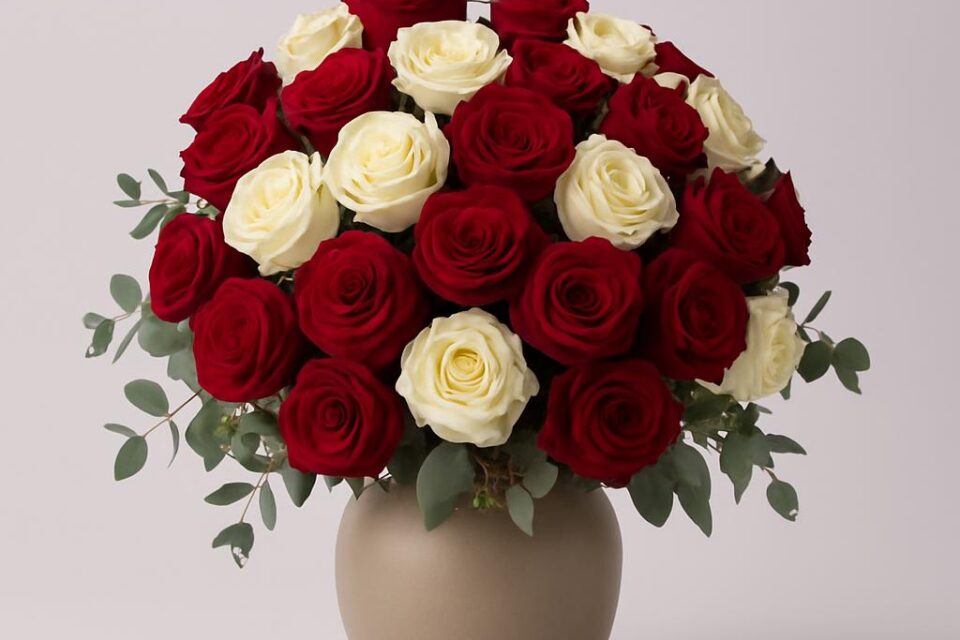
Large rounded bouquet of deep red and creamy white roses with grey-green eucalyptus foliage

Cut flowers > Rose bouquets

Red and White Rose Bouquet with Eucalyptus – Rosa × hybrida

Der rot-weiße Rosenstrauß aus 50 Rosa × hybrida verbindet dunkelrote und cremeweiße Blüten mit silbrigem Eukalyptus. Die rund gebundene, kontrastreiche Zusammenstellung eignet sich als Geschenk und als klassischer Vasenschmuck.

Statt 250,00 225,00 incl. VAT

All prices incl. VAT. plus shipping — delivery information

Only 5 left

Free pickup at our garden centre Courier delivery Vienna & surroundings Advice: +43 1 486 21 09
Order today — same-day pickup usually possible (Mon–Sat 8–18, Sun 9–16).
Fresh flowers & plants: our own courier delivers across Vienna and up to 25 km beyond. Durable items ship Austria-wide by post. Delivery details
Questions about this product? +43 1 486 21 09 or office@polisi.at

Category: Cut flowers > Rose bouquets · SKU: ROS-MIX-RW-EUC

Product details

This red and white rose bouquet of Rosa × hybrida features densely petalled blooms in deep red and creamy white. Airy eucalyptus stems frame the rounded arrangement with grey-green foliage.

The visible differences in colour and flower form indicate a mixture of modern cut-rose cultivars. No individual cultivar can be verified without a label, so a cultivar name has not been assigned.

For a longer vase life, recut the stems diagonally, remove any foliage below the waterline and place the bouquet in a clean, suitably tall vase. A cool position, fresh water and correctly measured flower food help keep the blooms presentable for longer.

Polisi plant knowledge

Care guide

The essentials first, followed by clear, practical details for every care topic.

Botanical nameRosa × hybrida; a mixture of modern cut-rose cultivars with no visually verifiable cultivar names
01

Watering

Fill a clean vase with approximately 500–1,000 ml of fresh water, or enough to reach one-half to two-thirds of the vase depending on its size. Check the level daily throughout the year—visual inspection of the vase replaces a finger test for cut flowers—and top up as needed in warm conditions. Replace all water at least every two days, rinse the vase and keep foliage above the waterline. Soil waterlogging does not apply to cut stems, but stagnant or cloudy vase water must be avoided.


02

Light

Place in bright or partially shaded light, away from direct midday sun. Strong sunlight increases water loss, wilting and colour fading.

03

Best location

Display in a stable vase in a cool position with little draught. Keep away from radiators, air conditioners and ripening fruit, as heat and ethylene shorten vase life.

04

Temperature

A temperature of approximately 15–22°C is ideal. The bouquet may be kept cooler overnight provided it remains frost-free; temperatures above 24°C noticeably accelerate ageing.

Foundation

Soil & nutrition

Humidity

Normal indoor humidity of around 40–60% is suitable. Do not mist the flowers, as persistently wet petals can encourage grey mould.

Soil

The cut bouquet requires no soil. Stem ends should stand only in clean vase water; soil or potting mix contaminates the water, encourages microbes and may block water-conducting tissue.

Nutrient needs

Cut-flower food provides a low-dose sugar source together with acidifying and hygiene components. Use it in proportion to the water volume, as directed by the manufacturer, throughout the bouquet’s vase life; no additional mineral nutrients are required.

Fertilising

Do not use ordinary houseplant or garden fertiliser. Add cut-flower food at every full water change, following the packet dosage exactly; an excessive concentration can damage stems and encourage bacterial growth.

Planting

This is a cut-flower bouquet and should not be planted. Loosen the binding only if a more open arrangement is preferred, and remove every leaf that would otherwise sit below the waterline.

Plant spacing

Arrange the stems so the flowers are not tightly compressed and air can circulate between the blooms. The vase opening should accommodate the tied stems without pinching them.

Through the year

Flowering & seasonal care

Flowering period

Densely petalled rose blooms in deep red and creamy white form the visible focal point. Greenhouse-grown cut roses are available throughout the year, while outdoor garden roses naturally flower mainly from late spring into autumn.

Pruning

Before placing the bouquet in water, use a clean sharp knife or secateurs to cut 1–2 cm diagonally from each stem. Renew the cut whenever the water is changed, and remove faded flowers or damaged leaves.

Repotting

Cut flowers cannot be repotted. At each water change, briefly remove the bouquet, clean the vase thoroughly, recut the stems and return them to fresh water.

Overwintering

Keep the bouquet frost-free in winter and away from radiators. Check the water level daily and replace the water after no more than two days; storing it in a cooler frost-free room overnight usually helps the petals remain firm.

Hardiness

Cut rose stems are not winter hardy and must remain frost-free. The hardiness of the parent plants varies by cultivar, which cannot be determined for this mixed bouquet, and does not apply to the cut product.

Plant profile

Growth & origin

Life cycle

The parent plants are perennial woody roses, but the bouquet consists of perishable cut stems. With suitable care, the blooms typically remain decorative for about 5–10 days, depending on initial freshness and room conditions.

Mature size

The visible bouquet is large, rounded and densely arranged. Cut roses typically have stems around 40–70 cm long; the final height and width of the display depend on trimming and vase choice.

Pot / sale size

No pot is required. A clean, stable vase measuring roughly one-third to one-half of the stem length is recommended, with an opening wide enough to hold the tied bouquet without crushing the stems.

Origin

Rosa × hybrida describes cultivated roses derived from complex horticultural crosses. The growing region of the pictured cut stems cannot be established visually, so no geographical source is attributed.

Propagation

The bouquet is not intended for propagation. Garden roses are commercially reproduced mainly by budding, grafting or cultivar-true cuttings; flowering vase stems do not root reliably.

Good to know

Healthy & safe

Safety and toxicity

Roses are generally regarded as non-toxic to people, dogs and cats, but commercially treated cut flowers should not be eaten. Thorns may cause injury; prevent ingestion of the eucalyptus and vase water, and keep the arrangement out of reach of children and pets as a precaution.

Common problems

Common issues include drooping flower heads from dehydration or blocked water-conducting tissue, rotting stems caused by bacteria-rich water, and grey mould on damp petals. Fresh cuts, a clean vase, frequent water changes and distance from ripening fruit reduce these problems.

Note: Location, season, pot size and weather can change the plant’s actual care needs.

Subtotal0,00  Cart